Turning
Turning consists of working on pieces that rotate around an axis.
- Different types
There are many types of lathes, including those that:
- can turn pieces several metres long and others only a few centimetres;
- can work animal materials such as bone, metals such as steel, copper and brass, natural materials such as wood, as well as many others including resin based materials;
- can hold workpieces on one side only, allowing for example the hollowing of the inside of vessels, or hold them on both sides to shape the outside of a piece
(it is also possible to hollow the inside while holding the piece on both sides; this technique was used in the Middle Ages to produce items such as bowls).
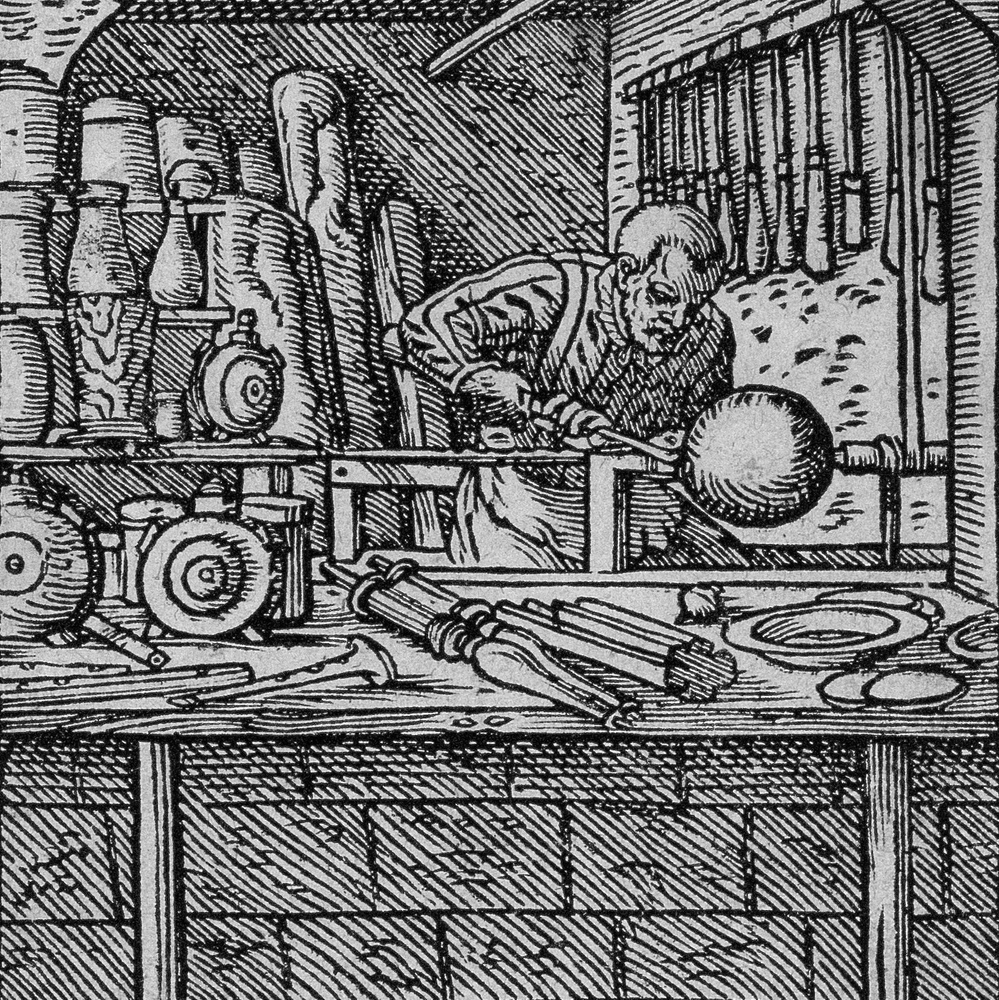
Processed image whose original comes from the Municipal Library of Lyon A16AMM000316
The turner by Jost Amman
Pole lathe in which the workpiece moves back and forth through foot powered motion.
- Making a lathe
We chose the simplest version of an ancient design, with a point on each side to hold the workpiece.
The next step was to decide on the material: wood, metal, stone or clay.
We chose metal, more precisely a cast copper alloy for the base, with hardened steel points.
- How an ancient lathe works
To operate this lathe, both hands are required.
The first hand rotates the workpiece using a cord wrapped around the wooden or metal piece, turning it in one direction and then the other, repeatedly.
The second hand holds the tools used to remove material and shape the form.
- Woodturning
When turning wooden pieces between two points, it sometimes happens that the pieces break.
Examples of broken pieces.
© Vison 2022 - Site internet créé avec iPaoo