Who we are
- The workshop and our beginnings
Founded in 2016, this workshop is the result of a path that combines horology and micromechanics.
From the beginning it became clear that there are many ways to manufacture an object and that some of them do not always correspond to the expectations of the workshop.
Each approach has its advantages and its limits. It was therefore necessary to learn how to choose the methods that match the vision and the constraints of the work being carried out.
- Two approaches to making an object
Let us take the example of making a watch. It can be approached in two very different ways.
The first consists of using only traditional techniques, faithful to the gestures and methods of craftsmen of the past.
The second relies on modern methods that use technology and computer controlled machines.
- The differences between traditional and modern techniques
Modern methods: precision and technological dependence
Modern techniques are characterised by extreme precision and by their dependence on technology.
Computer controlled machines allow exact and rapid production, but they require significant investment in equipment as well as constant access to sophisticated tools.
Their installation cost is often high and their use can create dependence on systems and technical maintenance.
Traditional techniques: skill, time and commitment
Traditional techniques rely on manual skill and on the mastery of tools made or adapted by the craftsman himself.
These instruments, often robust and simple, require repeated practice in order to reach the necessary precision.
Old tools are rare, sometimes expensive and are no longer produced, which makes their acquisition and maintenance difficult.
These methods demand strong commitment as well as patient and meticulous work.
- The choice of techniques
Each approach has its limits.
Modern techniques can be costly and may distance the craftsman from manual work, while traditional techniques require time, energy and dependence on tools that must be found, restored and maintained.
The workshop has chosen a third solution which consists of using simple tools, often made on site.
This approach makes it possible to remain free and creative while staying faithful to traditional craftsmanship.
It is directly inspired by medieval clockmakers who designed and made most of the instruments necessary for their work themselves.
These craftsmen were both tool makers and users, which gave them complete control over their craft.
- Heritage of the medieval clockmaker
The history of the medieval clockmaker is rich and reveals a fascinating body of knowledge.
Before becoming a profession in its own right, the clockmaker belonged to the guild of locksmiths and shared with them the practices of forging and mechanical work.
The first clocks were made from forged steel using simple tools.
Mastery of these instruments was essential, as each part had to fit perfectly into the overall mechanism.
This approach strongly inspires the working methods of the workshop, even in the creation of contemporary miniature objects.
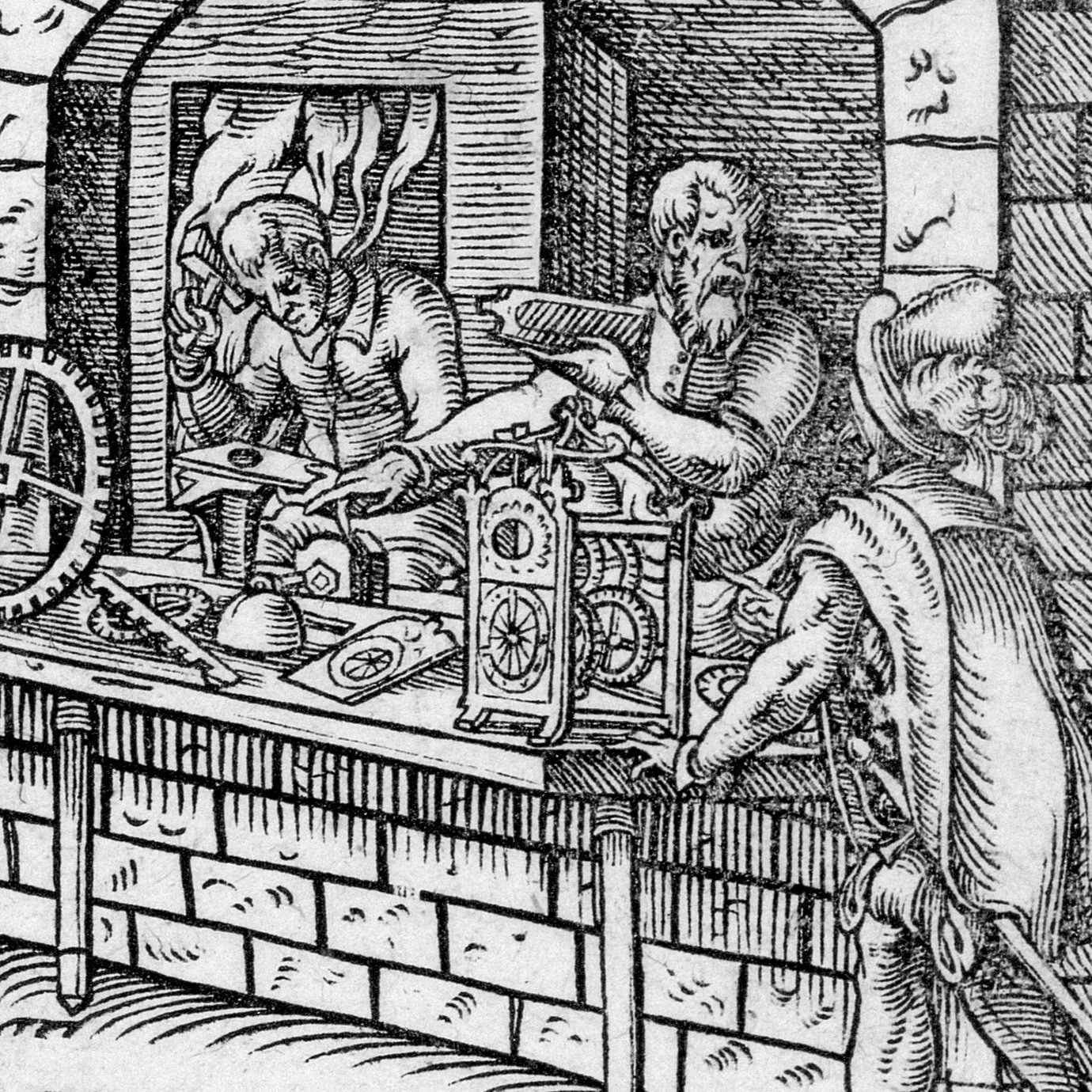
Edited image whose original comes from the Municipal Library of Lyon A16AMM000371
The Clockmaker by Jost Amman.
- The forge at the heart of the work
Gesture and material
The forge occupies a central place in the practice of the workshop because it connects present work with traditional knowledge.
As Diderot describes it: “To forge is to strike metal on the anvil with a hammer. One forges both cold and hot.”
Each movement and each blow influences the shape and the strength of the piece.
Essential forging tools
To forge, a few tools are essential.
The anvil, made of steel or stone, serves as a support for working the metal.
The hammer, with a wooden handle and an appropriate head, allows shape and precision to be given.
A source of air, often a wooden and leather bellows, feeds the charcoal hearth, which is itself built from earth and clay in order to heat the metal.
To be autonomous at the forge it is necessary to have knowledge in several fields such as steel, wood, clay and leather. Copper and bronze are also used.
- The materials used
Each of these materials is chosen for its quality, its capacity to be transformed and its compatibility with miniature work.
They are used both to make the tools and to create the objects themselves, which ensures consistency between the instruments and the pieces produced.
The workshop produces exclusively miniature objects, one of its specialities being the creation of mechanical automata.
These works can be discovered in the menu titled Creations.
To learn more about forging and about the other techniques used, it is possible to consult the Materials and Techniques section of the website.
© Vison 2022 - Site internet créé avec iPaoo